
How sponsor banks are using AI to launch new embedded banking programs with the team they already have

Embedded banking is back on the agenda at many community and regional banks, and the number of U.S. sponsor banks is on the rise. So it didn’t surprise our team that many of our conversations this year at Money20/20 revolved around embedded banking.
By putting their charters behind the products fintechs and non-bank brands offer, such as checking and savings accounts, credit cards, earned wage access, and BNPL, sponsor banks can earn fee income, gather deposits, and reach customers beyond their home market.
But with every new program comes an incremental oversight burden that typically necessitates hiring. This erodes the economics of potential new programs and can temper the ambitions of sponsor banks.
At least that had been the mindset. Now, through increased productivity, AI has the potential to absorb the incremental oversight burden and change banks’ staffing calculus, enabling them to launch more embedded programs with the headcount they have today.
The oversight work required by embedded banking programs
Sponsor banks carry regulatory responsibility for the actions of their partners, from consumer protection to financial crimes compliance to safe and sound operation. Before launch, that means reviewing more than a dozen aspects of each partner’s business, from its financial condition and information security to its subcontractors and insurance coverage, against the bank’s own standards.
After launch, the work becomes recurring. Sponsor banks monitor each partner to confirm it follows the bank’s policies, such as its BSA/AML, complaint management, credit, and new product approval policies, and they run partner compliance testing quarterly or more often. In some programs the partner will also run compliance functions for the bank, such as suspicious activity monitoring and customer due diligence, with the bank remaining responsible when the partner falls short.
An additional layer of review stems from the product being offered. For example, a debit card program requires the bank to ensure payment disputes are resolved within Regulation E timeframes. Deposit programs have carried a heavier load since 2024, when Synapse, which kept the records showing which customer owned how much of each pooled account at its partner banks, filed for bankruptcy. Within weeks, those banks lost access to the records, and the bankruptcy trustee later reported that customers were owed $85 million more than the banks held. Sponsor banks now hold the ledger themselves or reconcile it independently, which adds daily reconciliation and exception work to every deposit program.
Banks assess and monitor each partner on its own risk and complexity, so the work grows with every partner added. Rapid growth in the number of fintech partners, or in the size of any one partner's program, can leave a bank's risk management and operations struggling to keep pace. A 2026 OCC consent order against a federal savings association that grew its payment processing faster than its controls cited weak BSA staffing and alert monitoring that wasn't tuned to the new business.
Banks add capacity by hiring, and many sponsor banks now bring in outside compliance firms to run partner testing and monitoring. But both erode program margins, and responsibility for partners remains with the bank, including under the lighter guidance the agencies proposed in September. Its own staff still must review the results and stand behind them.
AI can take on review work, if it knows banking
Most of the added burden of partner programs is review work: searching for the right information, retrieving it, studying it closely, and comparing documents against standards and against each other. When AI is purpose-built for banking, it can handle all of these steps competently, across every partner at once. What follows is judgment: whether to accept a risk, grant an exception, or end a relationship. That judgment stays with human bankers.
The challenge is that general-purpose AI lacks the banking fluency to bring bankers reliable, audit-ready assessments for their review and sign-off. It doesn’t understand nuances in banking terminology, it doesn’t have fine-grained knowledge of the regulatory landscape, and it doesn’t understand a given institution’s policies, procedures, or tacit knowledge. It is therefore prone to providing wrong answers that sound confident, or citing rules for the wrong jurisdiction or timeframe. Further, it can’t show its reasoning in a way a banker or examiner can follow.
AI only saves a banker time if the banker can review its answer and sign off without redoing the work. That takes answers grounded in the bank’s own policies and sources, with reasoning the banker can follow.
Titan: Models, context, and agents that accelerate productivity while lowering risk
Titan automates the search, retrieve, stare, and compare task at the root of most banking work. Our platform begins with a unified context layer, bringing together comprehensive banking and regulatory knowledge into our Banking Knowledge Graph, and developing your unique Institutional Knowledge Graph, which embodies your policies, procedures, and tacit knowledge. Our family of Banking Models, including our flagship small language model, outperform the frontier on banking tasks. Titan speeds up the daily work of banking through our Foundry AI assistant, and through purpose-built Banking Agents that automate key workflows.
With Titan, a partner’s quarterly compliance test gets run against your policies, with exceptions flagged and a memo drafted, complete with citations, an assurance level, and an audit trail, all before a banker steps in. Once the banker receives this researched recommendation, they can focus their time on reviewing the recommendation and applying their judgment.
Titan is designed to solve for the risks of general-purpose AI by:
- Traveling to your data. Our Banking Models run inside your perimeter, so sensitive data never has to leave your institution. When a call goes out to a third-party model, PII is masked first.
- Showing its work. Every response comes with an assurance level and a full audit trail, so you can show an examiner how each partner alert was handled.
- Thinking like a banker. Our context layer and Banking Models are fluent across compliance, operations, risk, and finance.
- Keeping humans in the loop. Every workflow includes human review at each decision gate, with a named owner. Agents recommend, your team decides.
Every request follows the same six steps
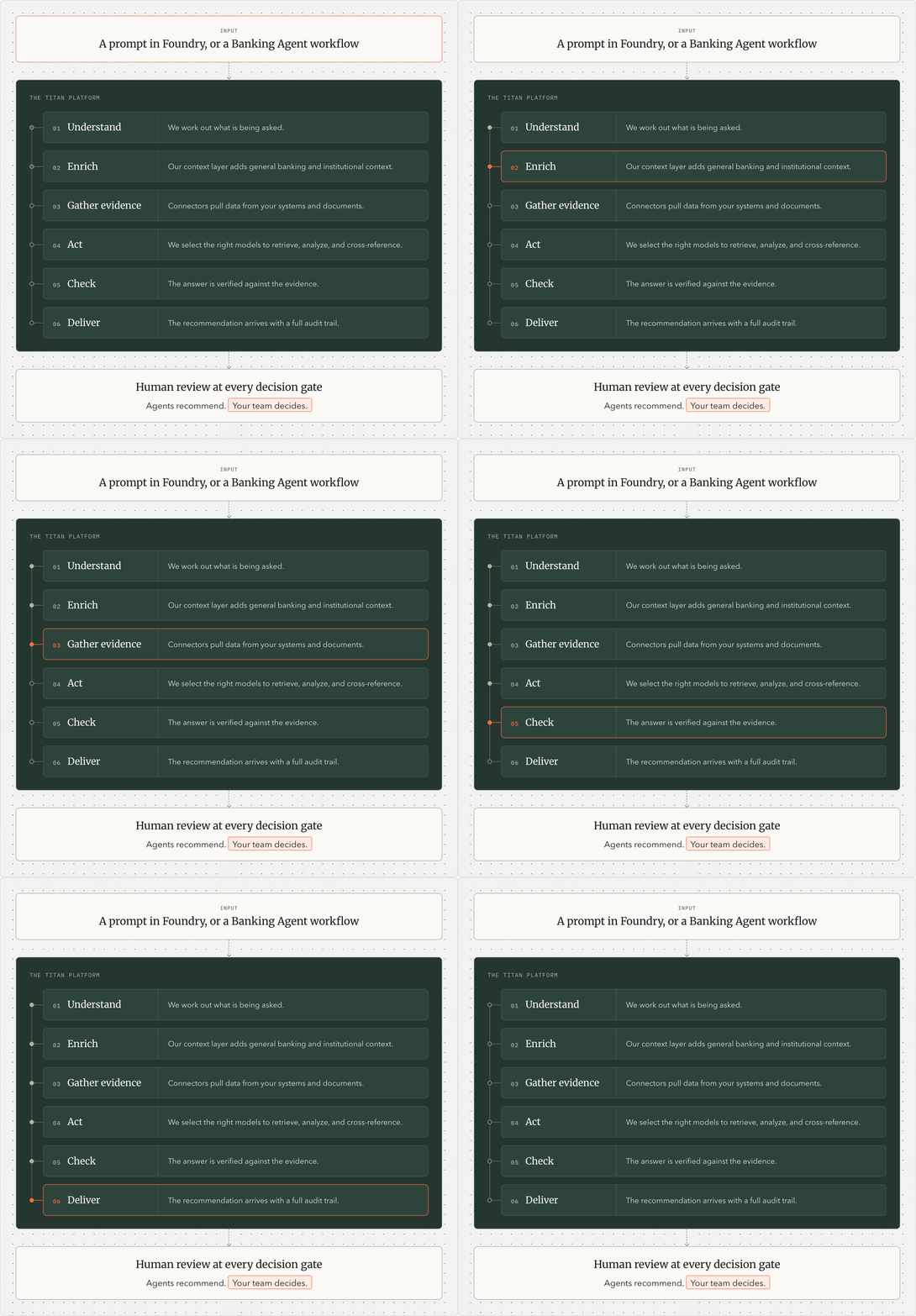
We build Banking Agents with you. Our forward-deployed engineers sit with your team to understand how the work gets done today before building anything. We then configure agents around your policies, and implement robust evals to ensure agents continue to perform well over time.
Titan supports the document-heavy stages of a partner program
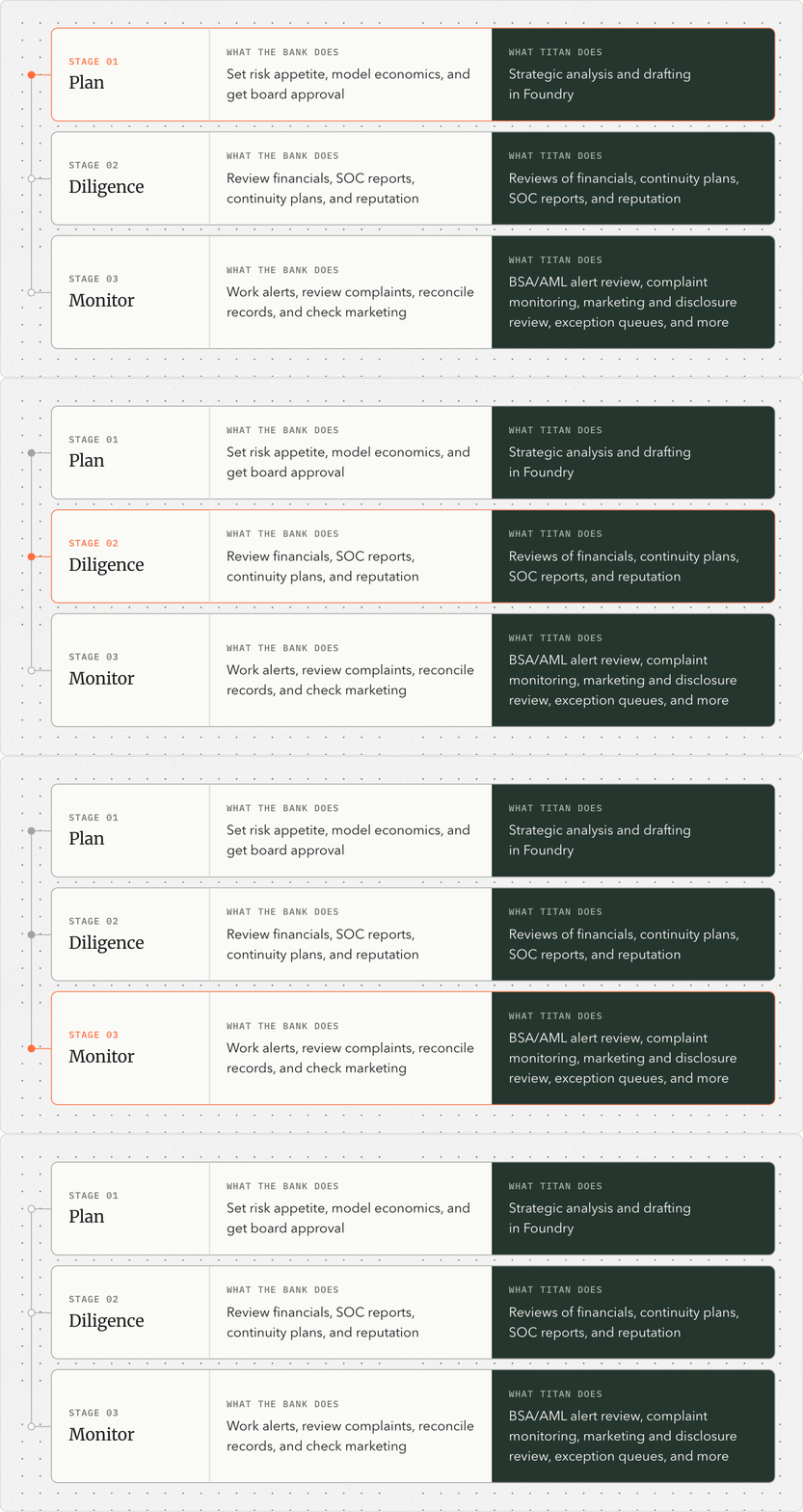
Within the document-heavy stages of a partner program, our Banking Agents can handle workflows like these:
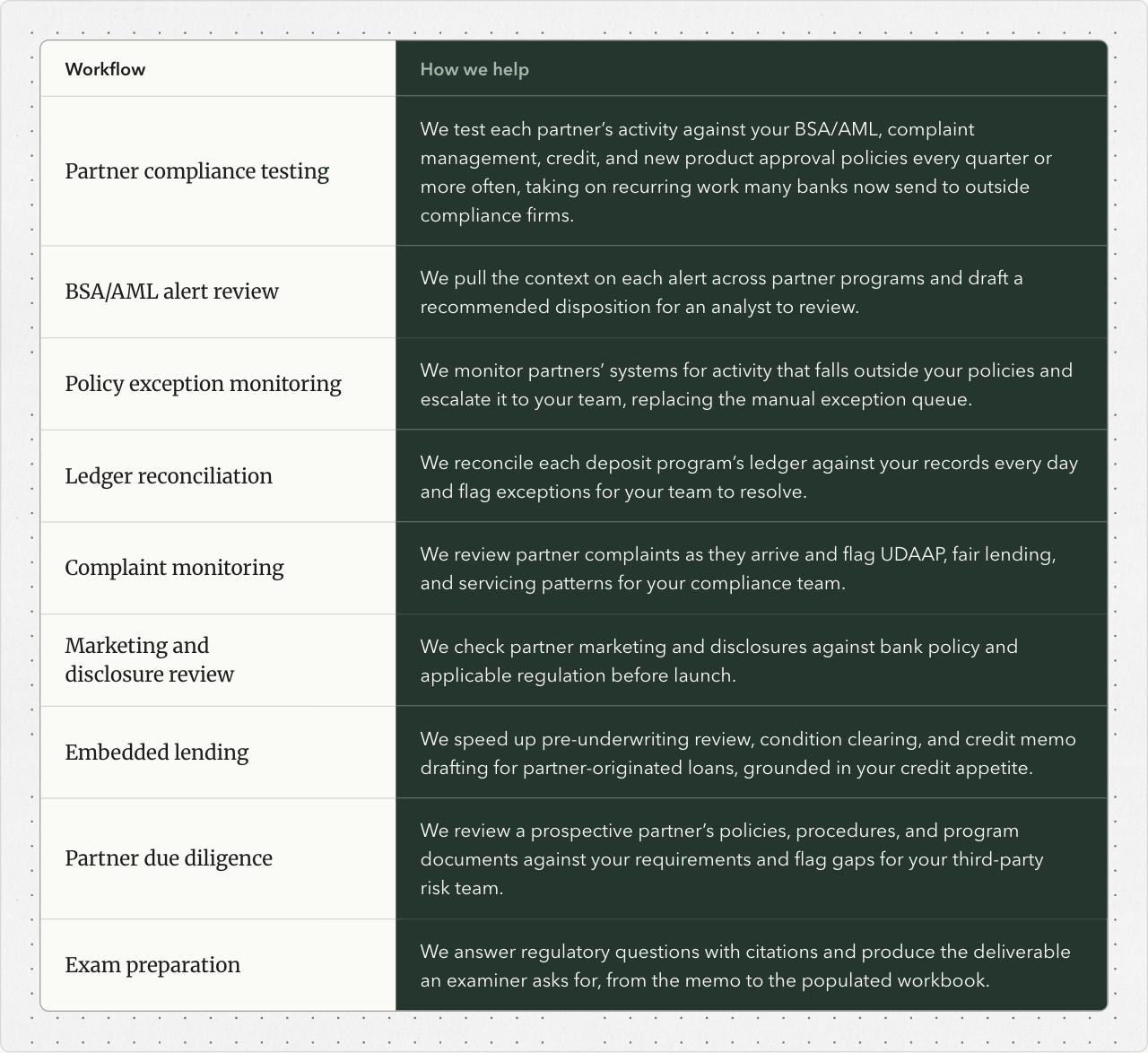
Our goal is to take care of the review work behind embedded banking programs, freeing up your team to launch programs it might not have been able to staff otherwise.
Four questions worth taking to your next leadership meeting:
- How many hours does each program type take our team every month?
- How do we find out when a partner falls outside our policies, and how many people does that take?
- Which program types would we take on if review work didn’t limit us?
- If our partner count doubled next year, would our compliance and operations team need to double too?
If you'd like to learn more about how Titan can help your team take on more embedded programs, reach out to us.